
Are you worried your hidden camera will die right when you need it most? Choosing the wrong power source can leave you with dead batteries and no footage. It’s a common problem that can undermine your entire security setup.
Hidden cameras get power in two main ways: from batteries or by being plugged directly into a wall outlet (hardwired). Battery-powered cameras offer flexibility, while hardwired ones provide constant, reliable power. The best choice depends entirely on how and where you plan to use the camera.
I remember talking with a client, Piotr Nowak from Poland, who runs a very successful e-commerce store. He was looking for a new line of hidden cameras for his customers. His main concern wasn't price, but reliability. "Taylor," he said, "my customers need to trust that the camera will work. If the battery dies unexpectedly, the product is useless." He's absolutely right. For business owners like Piotr, selling a reliable product is everything. It builds trust and brings customers back. This is why understanding the power source is so important. It’s the heart of the camera. It determines where you can place it, how often you need to interact with it, and ultimately, how dependable it will be for your customers in the long run.
You're considering a battery-powered camera for its flexibility, but you're worried about it dying. How long can you really expect it to last? It’s a critical question I get all the time from distributors.
The truth is, battery life varies a lot. It can range from just a few hours to several months on a single charge. A camera in a high-traffic area recording constantly will drain its battery much faster than one in a quiet room that only wakes up when it detects motion.
I once had a customer in France, let's call him Sossa Larsso, who bought a batch of mini cameras for his retail chain. He called me a week later, concerned that the batteries weren't lasting as long as he'd hoped. We walked through his setup, and it turned out the cameras were placed in a busy storefront, recording continuously in high-definition. They were working perfectly, but the workload was immense. We switched the settings to a lower-power motion detection mode, and the battery life jumped from one day to over a week. This experience taught me how vital it is to educate my clients on proper usage. It's not just about battery capacity; it's about matching the camera's settings to the environment. For my B2B clients, providing this knowledge is key to their success and, in turn, my own.
| Feature Setting | Estimated Battery Impact | Best Use Case |
|---|---|---|
| Continuous Recording (1080p) | High Drain (Hours) | Short-term, active monitoring |
| Motion Detection (High Sensitivity) | Medium Drain (Days) | Busy areas like entrances or hallways |
| Motion Detection (Low Sensitivity) | Low Drain (Weeks) | Quiet rooms or storage areas |
| Standby Mode (PIR Sensor) | Very Low Drain (Months) | Long-term, infrequent monitoring |

What is the disadvantage of using a wireless security camera?
When people hear "wireless," they often think it means no wires at all. But in the world of security cameras, that's not always true. This confusion can lead to problems if you don't know what you're buying.
The biggest disadvantage of a truly wireless camera—one that runs on batteries—is the maintenance. The battery will eventually die. This means someone has to physically access the camera to recharge it or swap the batteries. For a business owner in Italy like Daniel Adriano, who sells to homeowners, this can be a big deal. His customers want a "set it and forget it" solution. If they have to climb a ladder every few weeks to charge a camera, they won't be happy. This is a real pain point. Another issue is that in very cold weather, battery performance can drop significantly. I always make sure my European clients, especially those in colder climates like Poland, are aware of this. We at QZT focus on high-quality batteries to minimize these issues, and all our products have the CE and ROHS certifications to prove their safety and performance, which is a non-negotiable for experienced buyers.
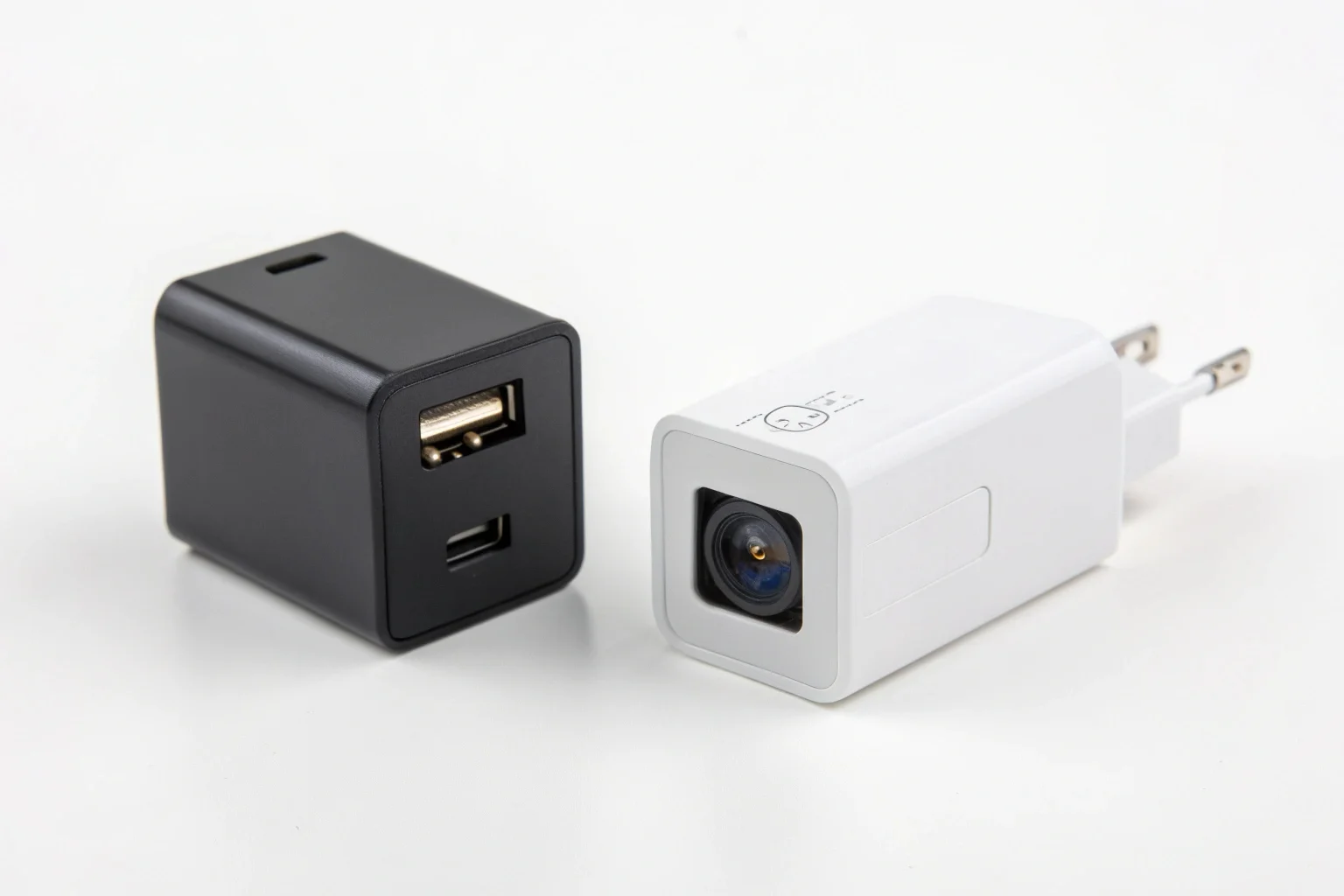
Hardwired cameras solve this problem completely. They draw power from an outlet, so they never need charging. Many of our most popular models are disguised as everyday objects, like a USB wall charger or a clock radio. They blend in perfectly and get a constant, reliable stream of power. This is the ultimate "set it and forget it" solution. It offers continuous surveillance without any worry about a dead battery, providing total peace of mind. For a retailer, this is a powerful selling point.

What is the difference between a wireless camera and a Wi-Fi camera?
You might see the terms "wireless camera" and "Wi-Fi camera" used as if they mean the same thing. They don't. Understanding this difference is crucial for picking the right product for your customers. It's a technical detail that separates the pros from the amateurs.
A "wireless camera" is really talking about its power source. It means the camera runs on batteries, so you don't need to plug it into a wall. This gives you the freedom to place it almost anywhere. A "Wi-Fi camera," on the other hand, is talking about how it sends its video signal. It uses your local Wi-Fi network to stream footage to a smartphone, tablet, or computer. This is how you get those convenient remote viewing features. The key is that these two things are independent. You can have a battery-powered camera that doesn't have Wi-Fi; it just records to an internal memory card. And you can have a Wi-Fi camera that needs to be plugged into the wall.
I make sure to clarify this with all my clients. For example, Agnieszka Daniel, a distributor in Poland, needs to create accurate product listings for her e-commerce site. If she labels a hardwired Wi-Fi camera as "completely wireless," her customers will be confused and disappointed. Getting the terminology right builds credibility. At QZT, many of our most advanced cameras are both: they have Wi-Fi for remote viewing and are hardwired for constant power. This combination offers the best of both worlds: convenience and reliability. And since we have a warehouse in Italy, we can ship these products to clients like Agnieszka in just a few days.
| Camera Type | Power Source | Data Transmission | Key Feature |
|---|---|---|---|
| Wireless Camera | Battery | Internal Storage (usually) | Placement Flexibility |
| Wi-Fi Camera | Hardwired (usually) | Wi-Fi Network | Remote Viewing |
| Wireless Wi-Fi Camera | Battery | Wi-Fi Network | Both Flexibility & Remote Viewing |
Conclusion
Choosing between battery and hardwired power is about balancing flexibility with reliability. Understand your needs, and you'll find the perfect hidden camera solution to give you peace of mind.

 English
  Italiano
  Deutsch
  Français
  Español
  Polski