
Frustrated by bulky, obvious voice recorders that fail at critical moments? You need clear, discreet audio capture without worrying about battery life or drawing unwanted attention. The right device makes all the difference.
The most important factors for a live listening voice recorder's performance are crystal-clear audio quality (bitrate), long battery life, sufficient storage capacity, and a discreet design. These features ensure you capture everything you need, reliably and without being noticed, which is crucial for business applications.
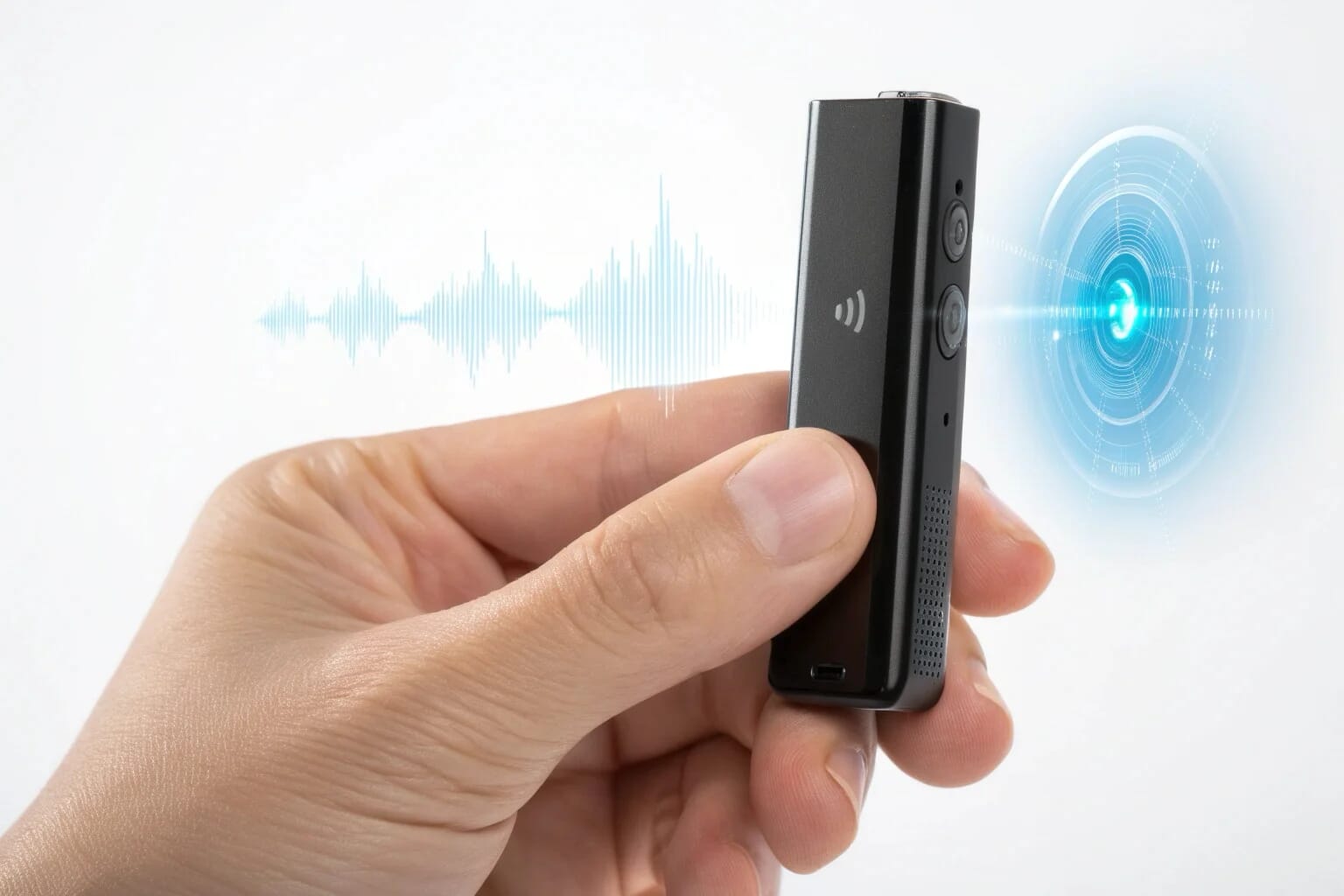
As a manufacturer, I've spoken with hundreds of business owners like Daniel Adriano in France. They tell me the same thing: their customers need devices that are not just effective but also simple and reliable. It’s not about having the most features; it’s about having the right ones that work every single time. This is why we focus on practical performance. We help our clients find the perfect balance of features, so they can offer products that their customers trust. It's about building a reputation for quality, one device at a time.
What features make a voice recorder good?
Are you feeling overwhelmed by confusing technical specs? Choosing a recorder based on the wrong features can lead to missing crucial details in a recording. Focusing on practical, key functions ensures you get a reliable and easy-to-use device every time.
A good voice recorder has essential features like one-key recording for simplicity, voice activation (VOR) to save battery and storage, and sometimes a strong magnet for easy placement [5]. A timestamp function is also crucial for organizing recordings and providing evidence if needed [3][6].

When I work with B2C e-commerce store owners, I always emphasize that the best features are the ones that solve a real problem. For instance, voice activation is a game-changer. Instead of recording hours of silence and wasting battery, the device only records when it detects sound. This is a feature our partners highlight because it makes the product much more efficient. We've also seen great success with models that have a Type-C interface, as they allow for quick file transfers to a phone, which is a major convenience for users on the go [5]. You can explore our full range of mini voice recorders to see these features in action. The key is to match these practical functions to what your end-users truly need.
Core Features for Performance
| Feature | Why It Matters for Business | Example Model |
|---|---|---|
| One-Key Recording | Ensures the device can be started quickly and discreetly, without fumbling with complex menus. | S8 Watch Recorder [2] |
| Voice Activation (VOR) | Maximizes battery life and storage space by only recording when sound is detected. | ZD46 [1], C17 [5] |
| High-Quality Bitrate | A higher bitrate (e.g., 192Kbps or more) means clearer, more detailed audio. | Q70 (192Kbps) [5] |
| Timestamp Function | Embeds the date and time into the audio file, which is vital for evidence and organization. | ZD58 [3], Q61 [6] |
| Discreet Design | Allows the device to blend into its environment (e.g., a pen, keychain, or watch). | Q90 Pen [1], M1 Key [3] |
Is it better to get 128GB or 256GB?
Are you worried about running out of recording space at a critical moment? Choosing the wrong storage capacity can cut off important conversations right in the middle. Understanding your actual needs helps you pick the right size without overspending on space you won't use.
For most business audio recording needs, 16GB to 32GB is more than enough, offering hundreds of hours of recording time. A 16GB device, for instance, can typically store around 192 hours of high-quality audio [3][6]. Larger capacities like 128GB are usually for video or continuous, multi-day audio surveillance.

I often explain to my clients that storage capacity is directly linked to audio quality, or bitrate. A higher bitrate creates a larger file, so it uses more space. For clear voice recordings, a bitrate of 192Kbps is a fantastic standard that balances quality and file size perfectly [1][5][6]. While some of our advanced hidden cameras support up to 128GB for high-definition video [6], it's overkill for audio-only devices. My advice is to focus on the recording hours. For a business owner in Italy like Sossa Larsso, knowing that a 32GB device can hold nearly 400 hours of meetings is much more valuable than just seeing a large gigabyte number. It provides peace of mind.
Storage vs. Recording Time (at 192Kbps)
| Storage Capacity | Approximate Recording Hours | Best For |
|---|---|---|
| 8GB | ~96 Hours | Short meetings, personal notes |
| 16GB | ~192 Hours | Multiple long interviews, lectures |
| 32GB | ~384 Hours | Extended monitoring, weekly archiving |
| 64GB | ~768 Hours | Continuous, long-term recording needs |
How long does a spy voice recorder last?
Does your current recorder die at the worst possible moment? A short battery life is one of the most common points of failure for any electronic device. Choosing a spy recorder with a long working time isn't just a convenience—it's critical for reliability.
A spy voice recorder's battery can last anywhere from 20 hours to over 500 hours, depending on the model and its battery capacity. Our Q70 model, for example, is a powerhouse that can record for about 30,000 minutes (500 hours) on a single charge [5].

When we talk about how long a recorder "lasts," we're really talking about two things: battery life and storage capacity. You need both to work together. A device with a massive battery is useless if its storage fills up in a few hours. That's why we design our products for balance. For example, our V90 recorder offers 2,400 minutes (40 hours) of working time, which is a great fit for its storage options [1]. A client in Poland, Agnieszka Daniel, needed a device for multi-day trade shows, and this balance was her top priority. We also offer highly discreet devices, like our wearable recorders, which are designed for extended, on-the-go use without needing a recharge. The key is to match the battery and storage to the specific job.
How do I choose a good spy voice recorder for your business?
Finding a trustworthy supplier for your niche electronics e-commerce store can be difficult. Many suppliers you find online lack proper certification, which puts your entire business at risk. Partnering with a verified manufacturer is the only safe and sustainable path forward.
For your business, the best approach is to choose a recorder from a reliable supplier who provides verifiable CE/ROHS certifications [1][6]. You should prioritize models with discreet designs, stable performance, and features that truly match your customers' needs. A long-term partnership with a trusted factory is your greatest asset.

I've built my career on creating these exact kinds of partnerships. A client I work with, let's call him Piotr Nowak from Poland, runs a multi-million dollar e-commerce site. He told me his biggest challenge was finding a manufacturer with genuine CE certificates for his niche products [1]. For him, verifiable compliance isn't a "nice to have"; it's non-negotiable for the EU market. That’s where we come in. With our Italian warehouse, we offer our European partners like Piotr fast shipping and local support. We provide all necessary documentation, including proper invoices and certifications. We even help clients with unique needs by offering customizable solutions with our DIY modules. By focusing on reliability and compliance, we help businesses like his thrive. We sell many discreet models, and our pen voice recorders are especially popular for professional use.
Conclusion
To choose the best voice recorder, focus on audio quality, battery life, and storage. Most importantly, partner with a reliable supplier who provides certified products for your market. For a reliable supply of certified, high-performance voice recorders, contact our team today.

 English
  Italiano
  Deutsch
  Français
  Español
  Polski